
Best Crypto Lawyers for Licensing, Compliance, and Regulatory Strategy
A founder in Singapore spent eight months and 60,000 USD on a licensing application. His law firm had a great reputation in corporate law. They had done a few crypto deals before. But when the Monetary Authority of Singapore asked detailed questions about transaction monitoring, the firm took three weeks to respond. The application stalled. The founder lost his lead investor.
That story repeats itself across the industry. The difference between a firm that gets licenses and a firm that makes applications drag on for years comes down to one thing: how many times they have done it before. Not crypto-adjacent work. Not a few ICO deals. Hundreds of licensing applications across multiple jurisdictions.
The five firms below have that kind of repetition. Their lawyers have sat across from regulators in Switzerland, Lithuania, the UAE, and Singapore. They know which questions will come before they arrive. They know what evidence regulators actually accept versus what the rulebook says they should accept.
Quick Comparison
Some firms cover one jurisdiction deeply. Others spread across twenty countries but only handle basic applications. The table below shows where each firm operates, what they do best, and what makes them different from the rest.
| Firm | Geographic Focus | Core Strength | Standout Feature |
| Gofaizen & Sherle | 50+ jurisdictions | Multi-jurisdiction licensing, AML/CTF compliance | Crypto License Navigator tool |
| DLT LAW | Global (US, EU, UK, UAE, LATAM, APAC) | Crypto-only practice, forensics, asset recovery | 2017-founded, pure crypto focus |
| Stalirov & Co | US, EU, UAE, Asia | MSB/MTL registration, FinTech integrations | 14 in-house lawyers, business analysts on staff |
| LEXR | Switzerland, EU | FINMA no-action letters, SRO affiliation | 2-hour workshop for CHF 3,800 |
| Buckingham Capital | UK, EU | MiCA CASP authorisation, passporting | Since 2013, end-to-end MiCA support |
The table gives you the quick facts. The sections below explain what working with each firm actually looks like when you are in the middle of an application, and the regulator starts asking hard questions.
1. Gofaizen & Sherle
As a crypto license service provider that has handled an enormous volume of licensing projects, Gofaizen & Sherle learned something early. Clients were picking jurisdictions based on forum posts rather than what fit their actual business. That frustration led them to build the Crypto License Navigator.
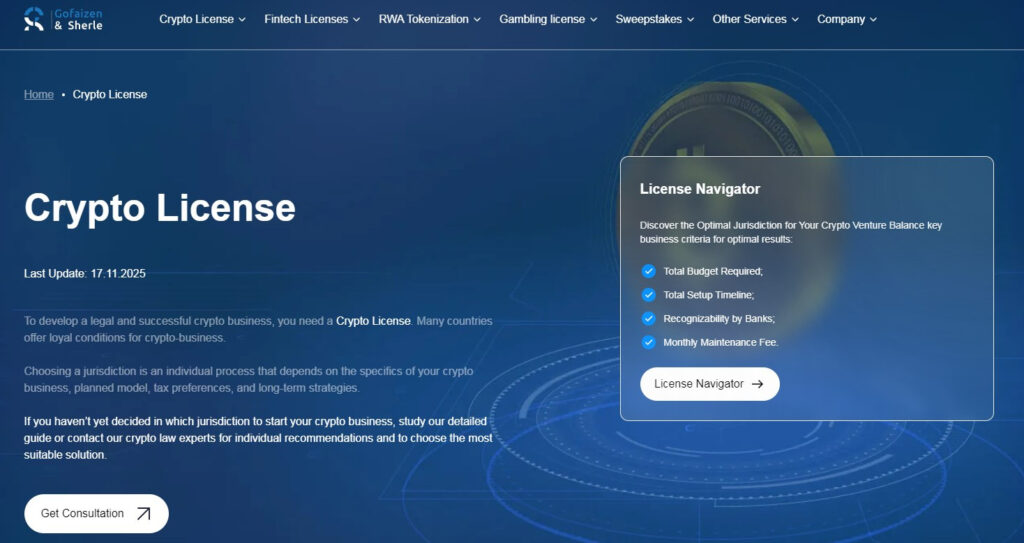
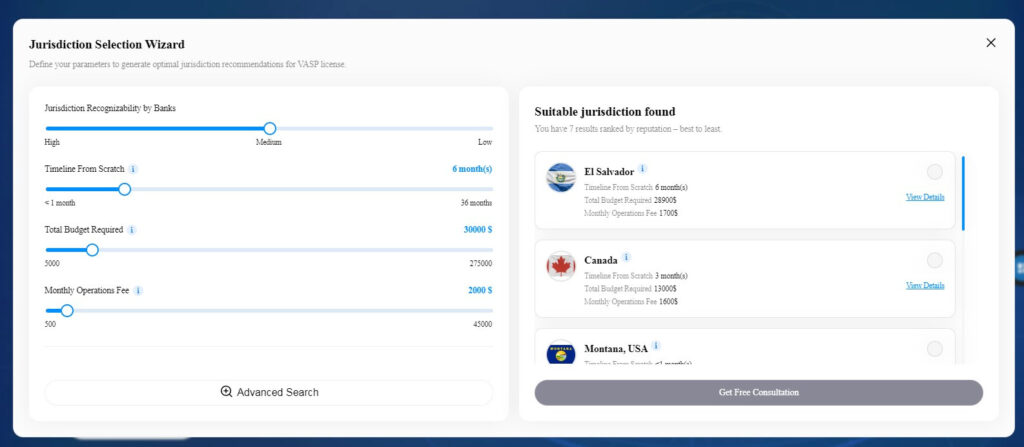
As a legal consulting firm for crypto business, their crypto lawyers built a tool that runs a client’s budget, timeline, banking needs, and monthly costs against 50+ jurisdictions and returns a shortlist of where they should actually apply.
- Licensing volume: Hundreds of projects completed across 50+ jurisdictions
- Hiring support: Helped clients recruit 200+ professionals, including compliance officers and top management
- Canada expertise: Their legal consultants for crypto licensing help clients register as Money Services Businesses (MSB) with FINTRAC.
- El Salvador track record: 4 DASP licenses secured out of approximately 40 issued
- MiCA readiness: Navigator includes CASP requirements for EU member states
- What makes them different: They do not wait for clients to pick a jurisdiction. The Navigator forces clients to answer questions about their business model before they start looking at countries. That order prevents the common mistake of picking a location that looks good on paper but does not fit the actual services.
Their legal consulting services for crypto business setup and legal service to obtain a crypto license cover company registration, policy drafting, regulator conversations, and the compliance systems that keep everything running afterward. As a specialized crypto licensing firm, they run legal, corporate, and compliance infrastructure across multiple countries from a single point.
2. DLT LAW
DLT LAW started in 2017 when crypto licensing was not yet a category. Today, they operate as a specialized legal firm for obtaining crypto license with offices in Tel Aviv, Dubai, Limassol, and New York. Their partners came from the industry, not from corporate law firms.
- Forensics unit: Traces on-chain flows and builds evidence packages for regulators and courts
- Asset recovery: Pursues stolen, lost, or frozen crypto assets through exchanges and legal channels
- Web3 advisory: Translates technical decisions into legal and regulatory terms
- Tax practice: Cross-border tax strategy for founders and key individuals
- Privacy programs: GDPR, CCPA, and cross-border data transfer compliance
- What makes them different: They only do crypto work. Their partners hold tokens, use DeFi protocols, and stay inside the ecosystem. A client does not have to explain basic concepts to someone who learned about blockchain last week.
Their licensing practice treats applications as projects, not forms. They map out every regulatory touchpoint for a client’s specific services before drafting the first document. When the application goes in, they handle the back-and-forth until approval lands.
3. Stalirov & Co
Stalirov & Co operates with 14 in-house lawyers and business analysts who understand both the legal requirements and the operational reality of running a crypto exchange. They handle US MSB registration with FinCEN and state-level Money Transmitter Licenses across all 50 states.
- Intellabridge project: Full legal and compliance review covering Europe, USA, and Asia
- Integration work: Structured connections with Prime Trust (US crypto-custodian) and Solarisbank (German banking license)
- US coverage: MSB registration, state MTLs, SEC/CFTC compliance
- EU coverage: CASP licensing under MiCA, VASP registrations in Estonia and Malta
- UAE coverage: VARA licensing for Dubai operations
- What makes them different: They have business analysts on staff who understand payment integrations and technical infrastructure. When a regulator asks how transaction monitoring works, Stalirov & Co can explain the actual system, not just point to a policy document.
The firm does not just file applications. They review the actual product architecture, custody model, and data flows before drafting policies. Their client Hasher Wallet went through that process to align terms of use with how the wallet actually worked.
4. LEXR
LEXR has 30 legal professionals in Switzerland who have done blockchain work since 2016. Their focus is narrow: FINMA licensing and Swiss compliance structures.
They handle FINMA no-action letters, securities dealer licenses, and DLT trading facility applications. They know which SROs FINMA prefers for different business models.
- What the workshop is: Two hours with their legal, tax, and regulatory experts. The client gets structuring options, compliance requirements, and timelines specific to their business. Afterward, a written summary with next steps and fee estimates. Cost is CHF 3,800.
- Who runs it: Their lawyers hold crypto. They use DeFi protocols. They lecture at industry events and sit on Swiss Blockchain Federation committees.
- What makes them different: Most firms bill hourly while learning about the client’s business. LEXR charges CHF 3,800 for a session that tells clients whether Switzerland works for them before they pay for a full application.
5. Buckingham Capital Consulting
Buckingham Capital has been doing regulatory work since 2013, long before MiCA existed. When Lithuania switched from VASP registration to full CASP licensing, they already had the infrastructure in place to handle the transition.
- Lithuania focus: Company establishment, CASP application, compliance program development
- EU passporting: One CASP license covers all 27 EU member states
- Capital requirements: €50,000 to €150,000 depending on service classification
- Transition management: Helps existing VASPs switch to CASP before deadlines
- Post-licensing: AML program management, regulatory reporting, examination preparation
- What makes them different: They have been doing this work since before crypto licensing was a defined practice area. When MiCA launched, they did not have to learn the rules from scratch. They had already been helping clients meet similar standards for years.
They handle the full application chain. They set up the Lithuanian company. They prepare the CASP application. They build the compliance program. They talk to the Bank of Lithuania. For companies that already have a VASP registration, they manage the transition to CASP before the deadline passes.
Final Thoughts
The firms listed here all get licenses approved. That is the baseline. The difference shows up in what happens after.
Some hand you a PDF and disappear. Others install compliance systems, train your team, and stick around for the first audit. The best lawyers for obtaining crypto license fall into the second category.
A crypto license in 2026 starts a relationship that keeps going. Regulators expect regular reporting. They want to see policy updates. They conduct compliance audits. The license is the beginning, not the finish line.
The question is, who can keep you licensed when the rules change next year. The best legal crypto consulting firms build client relationships around long-term operational support, not one-off transactions.